Not every AI interaction needs to be documented.
Good governance should concentrate effort on meaningful organizational decisions.
FrostKey grew from a simple concern: law firms were being encouraged to adopt AI quickly, but many lacked a practical way to manage the responsibility that came with it.
FrostKey grew from experience in software, product design, development, technical solution selling, and helping organizations introduce new technology into real-world operations.
As we researched how different industries were adopting AI, law firms stood out as facing some of the most immediate risk—and some of the clearest need for a better way to manage it.
Confidentiality, privilege, professional duties, client expectations, employee use, and rapidly changing technology were all converging at once. The opportunity was not to discourage AI adoption, but to help firms put practical structure around it before avoidable problems became more common.
The case made the concern tangible. It showed how the selection and use of a consumer AI platform could intersect with confidentiality, attorney-client privilege, and work-product protection.
It was no longer difficult to imagine how ordinary, well-intentioned AI use could create a serious problem for a law firm when the surrounding decisions, safeguards, and expectations had never been clearly established.
The opportunity was not simply to warn firms about AI risk. It was to help them put practical systems in place before isolated incidents became a larger and more common problem across the profession.
Firms needed a manageable way to establish expectations, approve tools and configurations, educate their people, maintain oversight, and preserve evidence of the decisions they had made.
The goal remains straightforward: help law firms use AI confidently while giving them a practical way to manage the responsibilities that come with it—without turning governance into unnecessary bureaucracy.
These ideas now shape both the FrostKey framework and the product.
Good governance should concentrate effort on meaningful organizational decisions.
Tools, capabilities, configurations, integrations, safeguards, and expectations all matter.
The system should reuse decisions, organize evidence, and make responsible use easier.
Policies, education, approvals, monitoring, reviews, and proof must stay connected over time.
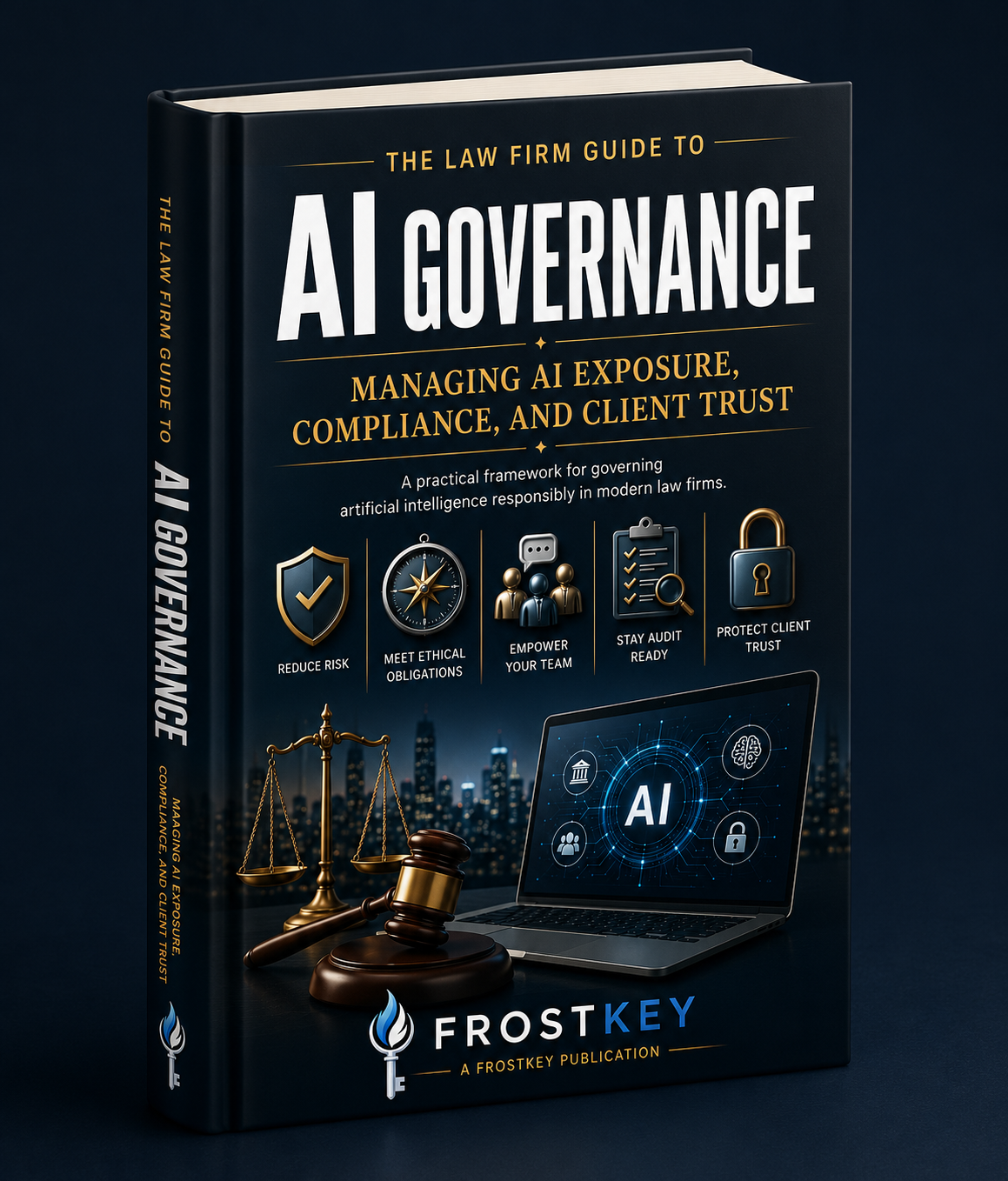
The Law Firm Guide to AI Governance was written to give any firm a practical place to begin. It brings together the ideas around policy, approved capabilities and configurations, education, oversight, maintenance, and proof in one accessible framework.
Today, FrostKey turns those same principles into an ongoing management platform that helps law firms establish, maintain, educate, monitor, and demonstrate responsible AI use.
The book explains the framework. FrostKey helps firms operate it.
Responsible AI is a serious responsibility. Managing it should still be practical.
Read the core beliefs guiding how FrostKey approaches AI Exposure, responsible adoption, governance operations, and evidence.