Traditional IT
Own software. Inventory assets. Configure systems. Deploy technology. This model is important, but AI capabilities can change faster than traditional technology inventories.
Instead of documenting every employee interaction with AI, firms should establish clear expectations, govern meaningful capabilities and configurations, educate their people, monitor change, and maintain evidence over time.
Traditional technology and compliance practices still matter, but neither fully addresses how artificial intelligence moves through people, information, vendors, and workflows.
Own software. Inventory assets. Configure systems. Deploy technology. This model is important, but AI capabilities can change faster than traditional technology inventories.
Write policies. Store documents. Conduct periodic reviews. This creates structure, but static documents alone do not operate an evolving AI program.
Govern meaningful capabilities. Educate people. Monitor material change. Maintain organizational decisions. Produce evidence as an outcome of the process.
These principles are designed to keep AI governance proportionate, practical, and focused on decisions that matter.
Focus on tools, models, capabilities, configurations, integrations, and material workflows—not every prompt or routine interaction.
AI Exposure matters more than simply asking whether the firm has adopted artificial intelligence.
Policies establish expectations. Operating programs connect those expectations to decisions, education, review, and evidence.
The same product can present different governance considerations depending on model selection, configuration, integrations, retention, and data access.
People make better decisions when they understand approved paths, risks, safeguards, and when to escalate questions.
Records should emerge from maintained decisions and participation—not be assembled from scratch only after someone asks.
AI capabilities, vendors, expectations, and professional guidance continue to change. Governance must be designed for review and adaptation rather than treated as an annual event.
The stages connect visibility, policy, approvals, education, monitoring, evidence, reporting, and improvement into one continuous governance program.
Identify where AI interacts with people, information, vendors, workflows, and business operations.
Define the firm’s governance position, responsibilities, acceptable use, restrictions, and escalation paths.
Evaluate and approve meaningful tools, models, capabilities, configurations, integrations, and safeguards.
Deliver practical education through FrostKey Academy, test understanding, and preserve training, acknowledgement, attestation, and participation evidence.
Track material legal, ethical, vendor, client, and internal developments and revisit decisions when needed.
Preserve policies, approvals, education, reviews, decisions, and supporting evidence as the program operates.
Explain the firm’s governance position, respond to scrutiny, identify gaps, and continuously improve the program.
Firms do not have to create the foundational curriculum themselves. FrostKey provides Responsible AI Foundations for Law Firms, including practical modules, a knowledge check, passing-score requirements, retry handling, completion tracking, and preserved participation evidence.
Each module also connects to relevant concepts from The Law Firm Guide to AI Governance as an optional deeper-learning resource.
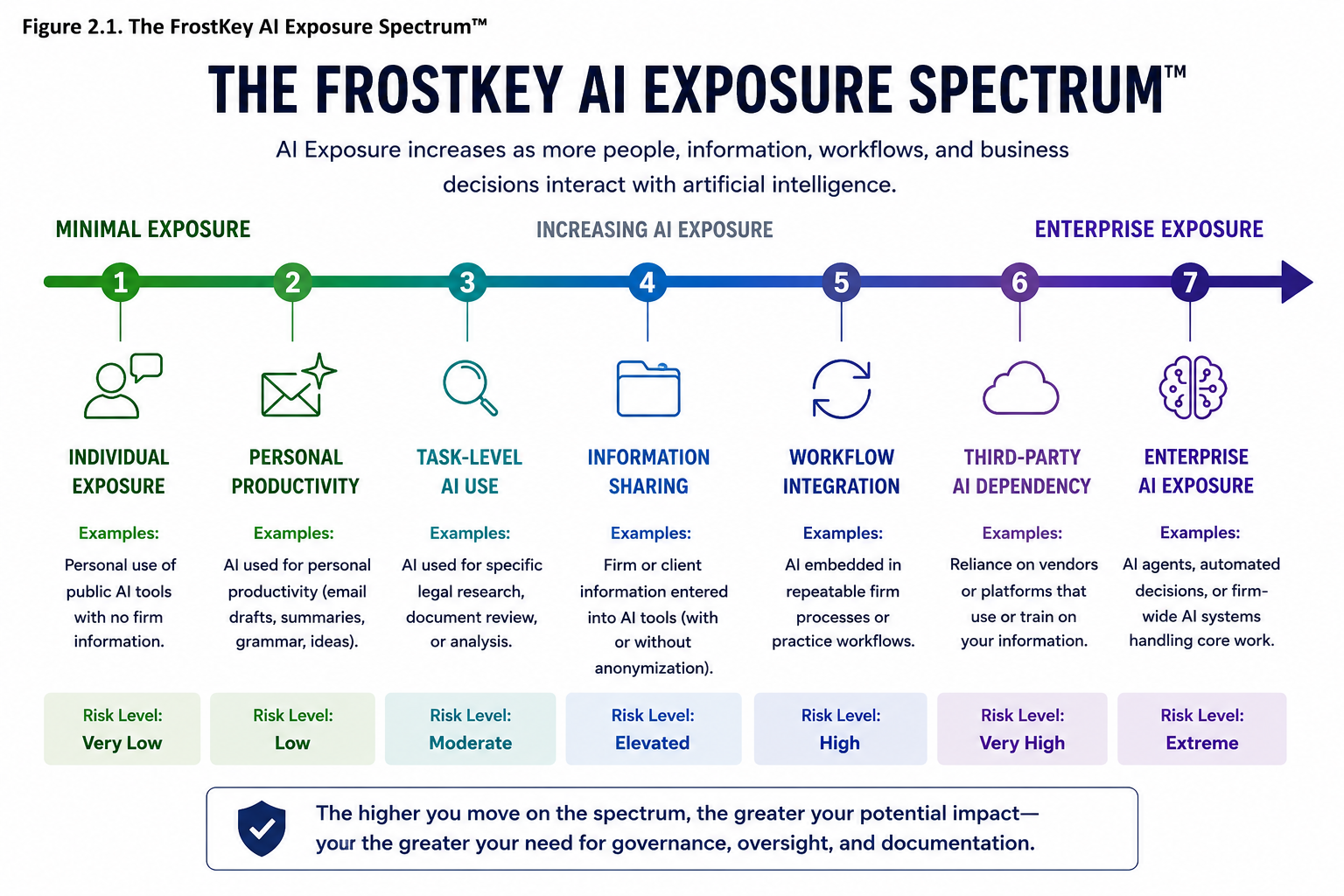
The important question is not simply whether AI exists inside the firm. It is where AI exists, what information it touches, which people and vendors interact with it, and whether appropriate governance exists at each meaningful point.
The FrostKey AI Exposure Spectrum™ shows how governance needs expand as artificial intelligence becomes more deeply embedded across people, information, workflows, vendors, and business operations.
Together, they help firms understand responsible AI governance, begin building it, and maintain it over time.
The Law Firm Guide to AI Governance explains the concepts, responsibilities, decisions, and practical reasoning behind the framework.
Download the Complete Guide — FreeFrostKey helps firms organize policies, approved capabilities and configurations, education, participation, monitoring, reviews, and evidence.
Explore the ProductThe goal is not to slow innovation. It is to create enough clarity, education, oversight, and evidence for firms to adopt AI with confidence.
Learn why FrostKey focuses governance on meaningful organizational decisions, enables responsible use within clear boundaries, and maintains evidence over time.